Herpetology - Captive Breeding
Artificial Incubation
Temperature variation
Background
Most captive breeders are aware that with some reptiles the sex of the animal is determined, at least in part, by the temperature at which the eggs are incubated. In my case, irrespective of species, I almost invariably achieve an approximate 50/50 sex ratio with normal artificial incubation periods . So, how do I do this?
Natural incubation characteristics
The first thing to remember is that very few reptile eggs are incubated at a constant temperature in the wild. Especially with reptiles from anywhere outside the tropics daily, even hourly, temperature fluctuations occur. Even within the tropics, at the very least, significant differences between night and day temperatures can occur. The greatest variation is with temperate species. As an example, I have measured the temperature at a number of Sand Lizard egg deposition sites in the UK - i.e. actually in the exact location and depth where the eggs were laid. The temperature dropped as low as 15 deg C and went as high as 40 deg C - and yet eggs incubated perfectly successfully. Typically, during the day, the temperature was between 20-25 deg C although a drop-off to 15 deg at night was commonplace. Yet, in a very warm summer 20 deg C was the minimum figure and temperatures in excess of 30 deg C were commonplace.
The initial solution
It has always seemed absurd to me that we then incubate such animals eggs at a constant temperature - a wholly un-natural scenario. I decided many years ago that I would go as far as practical towards emulating that natural variation. Initially, I simply used a very old poor quality thermostat in my incubator. This thermostat only has an accuracy of +/- 5 deg C. If, therefore, I set it on 25 deg C then incubation temperatures could fluctuate between 20 and 30 deg C. In practice because the temperature could continue falling or rising for a short while before a change in the thermostat state took effect the true range was 18-32 deg C. I therefore used a higher setting of 28 deg C producing a range of 21 deg C to 35 deg C. This worked perfectly resulting in 90-100% hatch of viable eggs with an approximate 50/50 sex mix. In all species the hatchlings were healthy and of normal size.
The more sophisticated - yet simple - solution
In time, the thermostat finally gave up the ghost. The quality of thermostats had improved immeasurably in that time which meant that they were accurate to within 1 deg C. Obviously this was totally unsuitable for this methodology without frequent manual temperature changes. Searching for a solution I was able to achieve one which probably matches natural temperature variation even better. This was achieved simply with the use of two thermostats and a timer. This meant that the primary temperature variation was between daytime and night time - exactly as in nature.
How it works
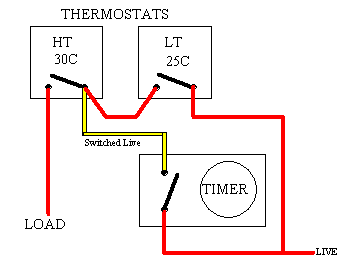
As can be seen from the diagram below, permanent power is fed to a "Low Temperature(LT)" thermostat. This is set at the minimum required incubation temperature. Its output is fed to the input side of a second "High Temperature (HT)" thermostat which is set at the maximum required temperature. This thermostat also has the timed (daytime) power connected to its input. Its output is fed to the load i.e. the incubator heater.
During the day (using the illustrative temperature noted on the diagram) if the temperature drops below 30 deg C the HT thermostat switches on and feeds power to the heat source until the required temperature is reached. It then switches off and there is no power to the heat source. The LT thermostat in this case is most unlikely to close as the temperature will not drop to anywhere near its setting. Even if it did, it would not matter as it would simply close the connection between permanent live and switched live which at that time are identical.
During the night there is no power switched to the HT thermostat. BUT, if the LT thermostat is calling (i.e. the temperature is below 25 deg C) then that thermostat feeds power to the input of the of the HT thermostat. At that temperature the HT thermostat is also calling so power is fed to the heat source.
The net result of this is that daytime temperatures (allowing for the fact that they will naturally continue to rise or fall for a brief while) will be between 28 and 32 deg C and night time temperatures between 23 and 27 deg C.
It should be noted that the timer should only be used for the incubator as the switched circuit will become live during the night when the LT thermostat is calling. This can be resolved by the use of relays.
Disclaimer
I would not recommend attempting to do this wiring unless you are thoroughly familiar with electrics. A professional electrician should be consulted. Note also that the wiring is more complex than shown as the negative and earth wires have been omitted for clarity - and the requirements in respect of them vary from one thermostat or timer to another. I will not be held responsible if anyone undertakes this without appropriate knowledge or does so illegally.
Example results
All of my eggs are incubated in the same incubator irrespective of the origin of the animals. I simply take advantage of the fact that heat rises. Even with a circulation fan, there is a 5 deg C temperature gradient from the bottom to the top of the incubator. Simplistically, I incubate temperate species in the bottom, Mediterranean or equivalent above them, sub-tropical above them and tropical at the top level.
In a typical year the following species were successfully incubated with an approximate 50/50 sex ration and a 90-100% hatch rate of fertile eggs simultaneously:-
| Species | Natural climate range (approx) | incubation period (days) |
| Lacerta agilis agilis | temperate | 32 |
| Lacerta agilis exigua | temperate/mediterranean | 35 |
| Lacerta viridis (bilineata) | temperate/mediterranean | 45-49 |
| Basiliscus vittatus | sub-tropical/tropical | 45 |
| Eublepharis macularis | mediterranean/sub-tropical | 45-55 |
| Gallotii stehlini | mediterranean/sub-tropical | 55 |
| Laudakia stellio brachydactyla | mediterranean/sub-tropical | 49-55 |
| Laudakia stellio picea | mediterranean/sub-tropical | 45-49 |
| Physignathus cocinchinus | sub-tropical/tropical | 58-63 |
| Podarcis sicula | mediterranean | 33 |